
In a year dominated by rapid advances in generative video models, one of the most talked-about companies is also one of the most secretive. A stealth startup founded by former senior researchers from SenseTime has reportedly reached a valuation exceeding $1.2 billion — despite having no public product, no demos, and barely any official communication.
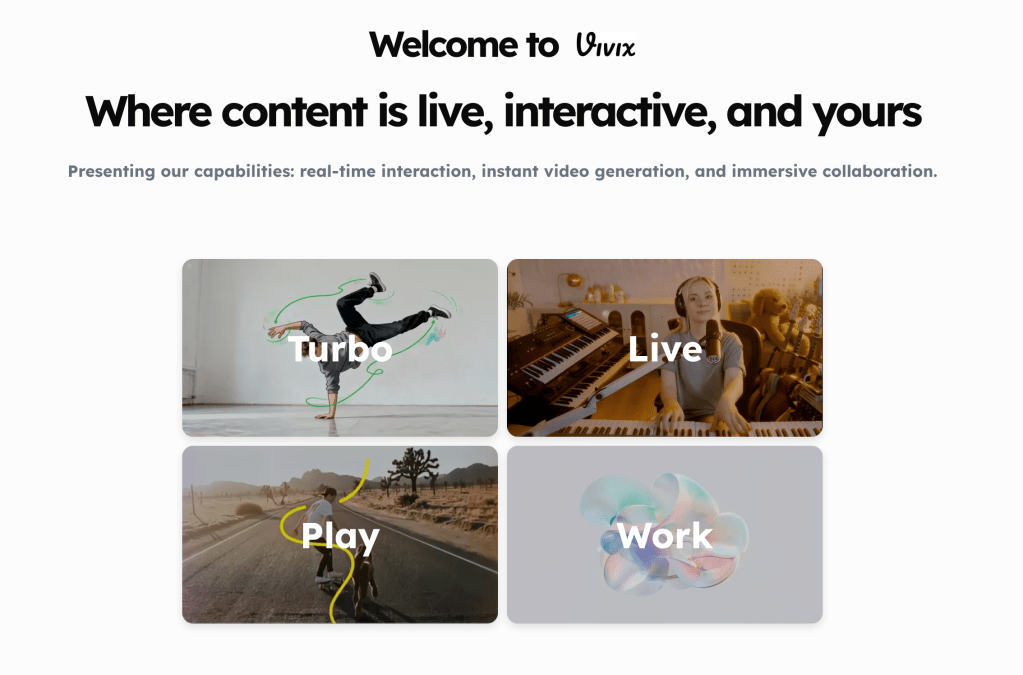
Industry insiders believe this mysterious venture is Vivix AI, a company whose public website (vivix.ai) hints at a next-generation visual creation engine but reveals almost nothing concrete. And yet, the hype around this unseen technology continues to surge.
A Billion-Dollar Valuation Without a Product
It’s rare — even in today’s overheated AI market — for a team to raise major funding and hit unicorn-plus status before launching anything. But the group behind Vivix AI isn’t a typical founding team: they include early architects of large-scale multimodal and generative research inside SenseTime, one of the world’s best-known computer-vision companies.
Investors are effectively betting on two things:
- This team knows how to build extremely ambitious visual models.
- They’re working on something fundamentally new — not just another image generator or video editor.
The fact that Vivix AI has remained fully silent publicly while still reaching a billion-dollar valuation only amplifies curiosity.
What Vivix AI Says It’s Building
Vivix AI’s website is sparse, but the language is unusually bold. It describes a:
“next-generation real-time interactive multimodal visual engine.”
Break down those words and a picture starts forming — not of a standard video model, but something more ambitious:
1. Real-time generation
This suggests on-the-fly creation of video or interactive scenes, not pre-rendered clips.
2. Interactive content
The output may respond to user actions, voice, gestures, or other inputs — almost like playable, dynamic media rather than passive video.
3. Multimodal understanding
Text, images, speech, or even camera input could all guide the system, blurring the boundary between “tool” and “environment.”
If accurate, this would place Vivix AI closer to the frontier of real-time synthetic media — a space only a handful of labs globally are exploring. Think: AI-driven virtual characters, dynamic story worlds, or responsive video creation that feels alive.
This is what makes Vivix distinct. While the broader market focuses on static image models or short-form video generation, Vivix appears to be chasing interactive, persistent, controllable AI-native experiences.
Why Industry Insiders Are Paying Attention
1. The founding team specializes in large-scale multimodal systems
Before Vivix, they were running major research efforts involving massive GPU clusters and pioneering real-time vision architectures. They have already built and shipped highly complex AI systems in the real world — a rare experience even in today’s market.
2. The timing is perfect
Generative video is moving fast, but interactive generative video is still unsolved. Whoever cracks that layer — latency, consistency, control — unlocks the next platform shift in media.
3. The investor confidence is unusually strong
When a still-stealth company surpasses a $1.2B valuation with no product, it signals deep conviction from top-tier funds that something disruptive is coming.
What the Product Might Actually Look Like
Because Vivix AI remains silent, the space is filled with informed speculation. Based on hiring patterns, website language, and research backgrounds, here are the leading hypotheses:
A Real-Time Video Generation Engine
Imagine a system where you describe a scene and it begins unfolding immediately — not rendering minutes later.
Interactive, AI-Native Worlds
Instead of generating a fixed clip, the engine creates an environment you can manipulate or converse with.
A Creative Tool for Storytellers and Developers
A next-gen engine for building dynamic content, characters, or playable narratives using natural language.
Whatever Vivix is building, it seems positioned somewhere between video generation, simulation, and interactive media technology — something closer to a new runtime than a traditional model.
The Strategic Silence
Vivix AI’s stealth mode is not an accident. By avoiding early demos:
- The company shields itself from premature comparisons.
- The team can scale infrastructure before public traffic hits.
- They can perfect consistency, temporal stability, and latency — the three hardest problems in video AI.
- And most importantly, they avoid becoming “just another video model.”
When the first public reveal comes, expectations will be sky-high. But that may be exactly what the company wants — to skip incremental releases and jump straight to a category-defining product.
Why Vivix AI Could Be the Most Important Visual-AI Startup to Watch
Even without a single released feature, Vivix AI has become one of the most anticipated players in next-gen generative media. The reasons are clear:
- Its founding team has already built large-scale multimodal systems at production level.
- Its ambition — real-time, interactive, multimodal visual generation — is exactly where the frontier is moving.
- Its valuation suggests investors believe it has a real chance of leading the next wave of AI-native content.
Most AI companies today generate images or videos.
Very few attempt to generate experiences.
Vivix AI appears to be aiming for the latter.
Until it launches, it remains one of the most intriguing mysteries in the global AI ecosystem — a billion-dollar bet on the future of real-time synthetic media.

 Top AI Product
Leave a comment