
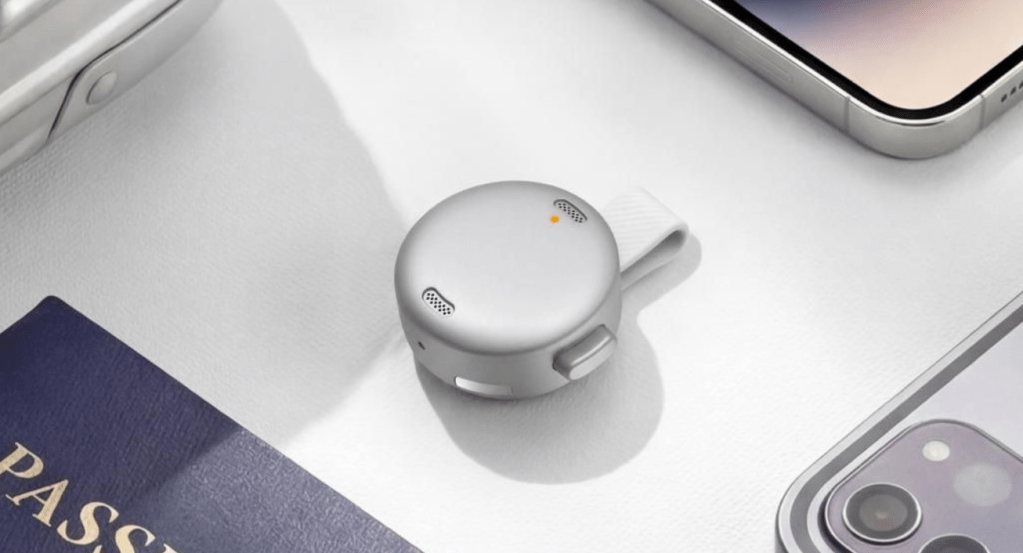
Anker and Feishu have transformed what could have been a simple recording accessory into a clear signal of how hardware and large-model AI are beginning to merge inside everyday work. The AI Recording Bean is not just a wearable recorder. It functions as a physical entry point into Feishu’s AI-native workspace, where speech is immediately converted into usable knowledge rather than archived as raw data.
The device itself is intentionally minimal: a small, lightweight recorder designed for constant, unobtrusive capture. On the hardware level, it does what good recording devices should do — reliable microphones, noise handling, and ease of use. But the product’s importance lies in what follows capture. Audio does not become a file to be managed later. It becomes a living document the moment it enters Feishu, searchable, editable, and embedded in ongoing work.
This matters because it collapses a long-standing divide between physical interaction and digital knowledge systems. Traditional recorders end at storage. Most AI meeting tools remain confined to software interfaces. The Recording Bean connects the physical world directly to an AI pipeline that structures speech into summaries, reasoning artifacts, and actionable outputs that can be queried and reused immediately.
The collaboration works because each side plays to its strengths. Anker brings hardware discipline that makes continuous capture realistic rather than intrusive. Feishu provides an environment where AI is not a feature but an organizing layer across messaging, documents, and knowledge bases. Together, they turn conversations into durable inputs for work, not transient moments that must be manually reconstructed.
More importantly, this shifts how organizational memory is formed. Spoken interactions no longer sit outside formal systems of record. They flow directly into them. Knowledge is created at the moment of conversation, not after the fact.
The AI Recording Bean is therefore less about recording and more about integration. It shows what happens when hardware stops being an endpoint and instead becomes a sensor feeding AI-native workflows. In that model, AI is no longer an external assistant. It becomes an ambient collaborator, embedded in how work is captured, processed, and remembered.

 Top AI Product
Leave a comment